


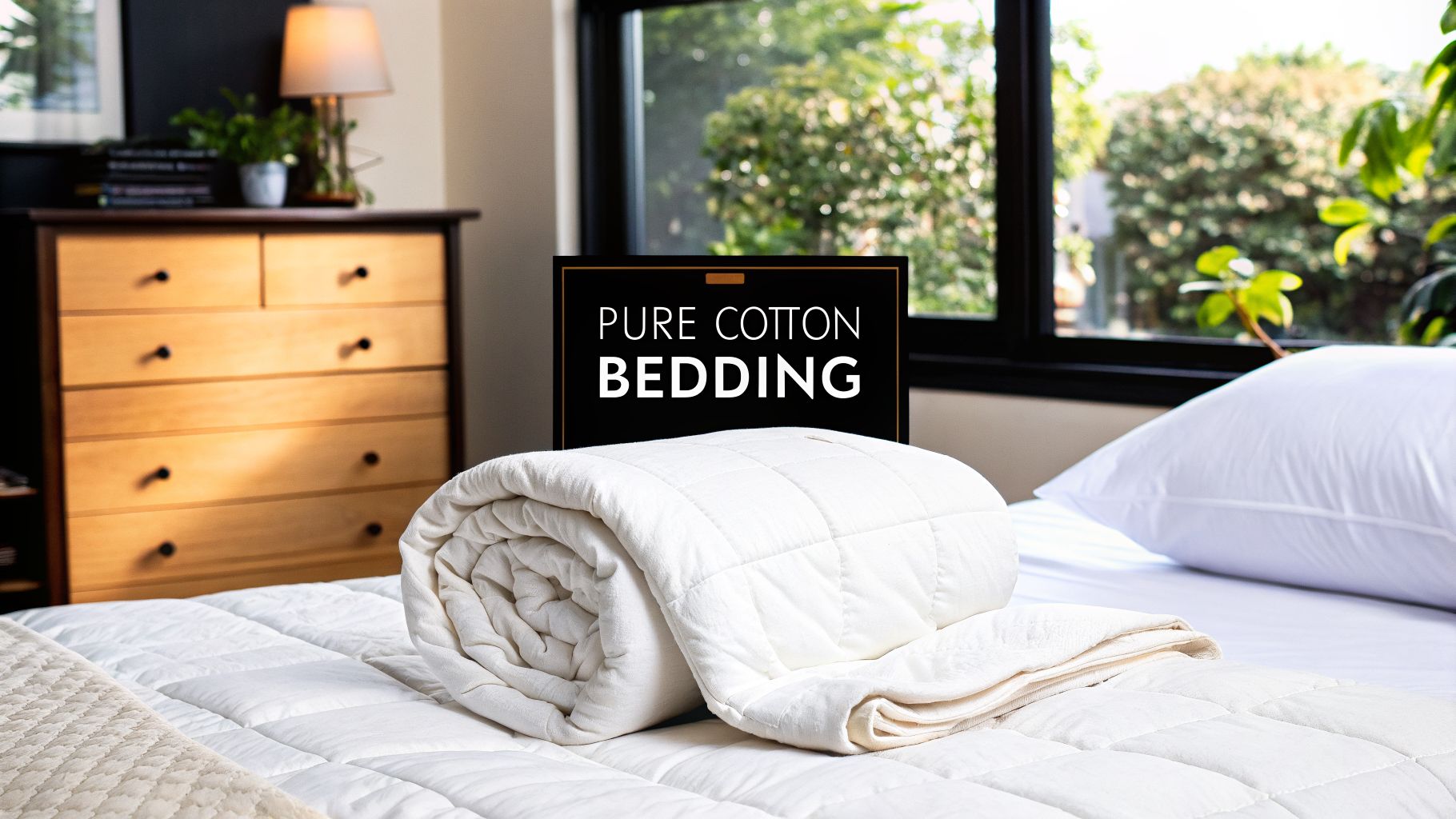
There's a certain magic to slipping between fresh, cool cotton sheets. It’s one of life’s simplest yet most profound comforts, and for good reason. Pure cotton is the enduring choice for millions because it’s naturally soft, breathable, and feels simply wonderful against your skin. It’s the difference between a bed that’s just a piece of furniture and one that’s a genuine sanctuary.
Why Pure Cotton Bedding Transforms Your Sleep

Choosing the right bedding goes far beyond colour or pattern. It is about crafting a personal retreat where you can properly rest and recharge. The material you sleep in every night has a profound impact on your comfort, and pure cotton consistently stands out as the superior choice. It is a natural fibre that works with your body, not against it.
This is not just a matter of opinion, the numbers speak for themselves. A staggering 64 percent of people prefer sheets made from cotton over any other material. Even more tellingly, 66 percent of shoppers will only purchase 100 percent cotton sheets, showing a deep seated loyalty to this classic fabric. When it comes to the ultimate test of comfort, an overwhelming 82 percent rated cotton as the most comfortable option available.
The Feeling of Genuine Comfort
The timeless appeal of pure cotton bedding lies in its honest, straightforward qualities. It delivers an unmatched combination of benefits that all contribute to a better, more restorative night’s sleep.
- Breathability: Cotton fibres are naturally porous, allowing air to circulate freely. This clever design helps wick moisture away from your body, preventing that sticky, clammy feeling you can get with synthetic fabrics and keeping you comfortably dry all night.
- Softness: There is nothing quite like the gentle touch of pure cotton. Its natural softness feels beautiful against the skin, and because it is hypoallergenic, it is the ideal choice for children, families, and anyone with sensitive skin.
- Durability: High quality cotton is built to last. The fibres are strong and resilient, meaning your bedding can withstand regular washing and daily use. In fact, many types of cotton get even softer with time, making it a sound, long term investment for your home.
Your bed should be the most comfortable place in your home. By choosing fabrics that feel good and support restorative rest, you are investing in your own well being. This small change can make a huge difference in your daily life.
To complete your cosy retreat, pairing your pure cotton sheets with the right top layer is essential. Our signature Snuggle Comforters are designed to harmonise perfectly with cotton, adding a beautiful layer of warmth and plushness without the fuss of a separate duvet cover. Together, they create an inviting bed that promises deep, satisfying rest. By learning how to sleep better at night, you can turn your bedroom into the ultimate haven.
Understanding Different Types of Cotton
When you see the words pure cotton bedding on a label, it is really just the starting point of the story. The true secret to that incredible, next level softness and durability lies in the specific type of cotton plant used. Think of it like cooking. You can have two cakes made from 'flour', but the one made with premium, finely milled flour will always have a better texture.
It all comes down to the length of the individual cotton fibres, what we in the industry call the ‘staple’. The rule is simple, longer fibres can be spun into finer, smoother, and stronger yarns. This is what gives you bedding that feels buttery soft against your skin, resists those annoying little bobbles, and actually gets better and cosier with every wash.
Upland Cotton: The Everyday Choice
Chances are, the vast majority of cotton in your home, from tea towels to t shirts, is Upland cotton. It accounts for a staggering 90% of all cotton produced worldwide, so it's the reliable workhorse of the industry. It creates a perfectly comfortable and serviceable fabric.
But, Upland's fibres are on the shorter side. This means that when spun into yarn, there are more tiny ends sticking out. Over time, this can give the fabric a slightly coarser feel and make it more likely to pill. It’s a solid, practical choice for daily use, but it does not quite deliver the lasting luxury of its premium cousins.
The Premium Cottons: Long Staple Stars
Once you step into the world of high quality bedding, you will start hearing about long staple and extra long staple cottons. These are the true celebrities of the textile world, prized for their remarkable qualities. The two names you will see most often are Pima and Egyptian cotton.
The single most important factor determining a fabric's quality is the length of its cotton fibres. Longer fibres create a smoother, stronger yarn, which results in bedding that feels softer and lasts for years.
These premium varieties have luxuriously long fibres, which allows them to be woven into fabric that is both incredibly smooth and impressively resilient. With fewer fibre ends, the material is far less prone to pilling or feeling rough. This is why you will notice a higher price tag. You are investing in a superior feel and a much longer lifespan for your sheets.
Egyptian Cotton: The Gold Standard
Grown exclusively in the uniquely fertile soil of the Nile River Valley, Egyptian cotton is renowned for its extra long staple fibres. The specific climate and nutrient rich earth create the perfect conditions for growing cotton with exceptional strength, softness, and absorbency.
So, what does that actually mean for your bedding?
- Exceptional Softness: Those long, fine fibres create a silky smooth surface that glides against your skin. Many people find that true Egyptian cotton becomes even softer and more inviting after each wash.
- Superb Durability: With fewer weak points, the yarn is inherently stronger and more resistant to stress. This means your sheets will last for years without thinning or wearing out.
- Vibrant Colour: The porous nature of Egyptian cotton fibres allows them to soak up dyes deeply and evenly, resulting in rich, beautiful colours that resist fading.
When you are ready to invest, it is crucial to make sure you are getting the real deal. To get a better handle on what to look for, you can explore our detailed guide on what makes Egyptian cotton bedding a truly worthwhile luxury.
Pima Cotton: America’s Luxury Fibre
Pima cotton is another outstanding extra long staple cotton, grown primarily in the southwestern United States, as well as in Australia and Peru. It shares many of the same beautiful characteristics as its Egyptian counterpart, offering a fantastic combination of softness and strength.
You will often find Pima cotton sold under the trademarked name Supima®. This is a brilliant mark of quality, as it certifies the product is made from 100% American Pima cotton. It gives you total confidence in its high calibre origins. Pima creates a wonderfully soft, lustrous fabric that is an excellent choice for pure cotton bedding.
Organic Cotton: A Kinder Choice for You and the Planet
Beyond the plant variety, the way the cotton is farmed makes a huge difference. Organic cotton is defined by what it does not have. It is grown without toxic pesticides, synthetic fertilisers, or genetically modified seeds. Choosing organic supports healthier farming practices that protect the soil, conserve water, and keep farmers safe.
For you, it means your bedding is free from potentially irritating chemical residues. This makes it a perfect choice for anyone with sensitive skin, allergies, or for families with young children. Look for certifications like the Global Organic Textile Standard (GOTS), which guarantees these eco friendly and socially responsible standards are upheld from the farm all the way to your bedroom.
Making Sense of Weave and Thread Count
When you are shopping for pure cotton bedding, you will constantly see the terms ‘weave’ and ‘thread count’. It is easy to get a bit lost. For years, we have been told that a higher thread count is the only thing that matters, but that is only one part of a much bigger story.
Think of the weave as the specific recipe for the fabric. It is arguably more important than thread count because it dictates the fundamental feel of the bedding against your skin. Two jumpers made from the same wool can feel entirely different based on the knit, and the same principle applies here. The way cotton threads are woven together creates a unique sleep experience.
Percale and Sateen: The Two Main Weaves
The two weaves you will encounter most often are percale and sateen. Each one feels completely different, so knowing what you are looking for is the key to choosing bedding you will genuinely love.
It helps to think of percale as your favourite crisp, white cotton shirt. It has a cool, fresh feel and a modern matte finish. This is created by a simple one thread over, one thread under grid pattern, a classic structure that allows air to circulate freely.
Sateen, on the other hand, is more like a luxurious silk blouse. It has an elegant, subtle sheen and feels incredibly smooth against the skin. Its one thread under, three or four threads over structure creates a wonderfully soft surface that drapes beautifully over the bed.

Percale vs Sateen: Which Cotton Weave Is Right for You?
Still trying to decide? This quick comparison breaks down the key differences between the two most popular pure cotton weaves to help you choose based on feel, temperature, and appearance.
| Feature | Percale Weave | Sateen Weave |
|---|---|---|
| Feel | Cool, crisp, and clean | Silky, smooth, and soft |
| Finish | Matte, with no sheen | Lustrous, with a subtle sheen |
| Temperature | Highly breathable and cool | Warmer and cosier |
| Best For | Hot sleepers, warm climates | Cooler nights, those with dry skin |
| Wrinkling | Prone to wrinkling, looks best ironed | Naturally wrinkle resistant |
| Durability | Gets softer with each wash, very durable | Slightly less durable due to the looser weave |
Ultimately, both are fantastic choices. Percale is perfect for that fresh, hotel sheet feeling, while sateen offers a touch more everyday luxury and warmth.
So, Where Does Thread Count Fit In?
Now that we have covered the weave, let us get back to thread count. Put simply, it is the number of threads woven into one square inch of fabric. A higher number just means the threads are packed together more densely.
For years, marketing has championed the idea that thread counts of 800, 1,000, or more are the pinnacle of luxury. In reality, this can be misleading. In some cases, an extremely high thread count is achieved by using thinner, weaker threads to artificially inflate the number, resulting in a fabric that is less breathable and durable over time.
A good quality cotton with a moderate thread count will often feel much better and last longer than a poor quality one with an inflated, sky high count.
As a rule of thumb, the sweet spot for quality bedding is a thread count between 200 and 500. In this range, you will find beautifully made sheets that are soft, breathable, and designed to last. To go a bit deeper, our guide explores the best thread count for sheets in more detail.
Ultimately, choosing comes down to personal preference. Here is a quick summary to guide you:
-
Choose Percale if: You are a hot sleeper, live in a warm climate, or just love the feeling of slipping into a cool, crisp bed. It is an absolute dream in the summer.
-
Choose Sateen if: You prefer a warmer, cosier bed, have sensitive skin that loves a silky smooth touch, or want a more opulent look with that beautiful, subtle sheen.
The best pure cotton bedding is always a marriage of high quality cotton and a weave that suits your personal sleep style. Do not get distracted by the chase for an impossibly high thread count. Focus on how you want your bed to feel, and let that be your guide.
How Cotton Compares to Other Bedding Materials
Choosing new bedding can feel overwhelming. With so many materials on the market, it is easy to get lost. While pure cotton has been the go to choice for generations, it is worth taking a moment to see how it really measures up against other popular options like polyester, linen, and bamboo.
By looking at how each fabric performs, night after night, you start to see why cotton so often comes out on top for all round comfort and practicality.
The most common alternative you will find is polyester, a synthetic fabric that dominates budget friendly bedding. While the low price point is tempting, its biggest failing is a lack of breathability. Unlike natural fibres, polyester traps your body heat and any moisture, which can lead to that clammy, uncomfortable feeling, especially on warmer nights.
Even with modern microfibres making polyester feel softer than it used to, they simply cannot mimic the natural temperature regulation of pure cotton. Cotton works with your body, wicking away moisture to keep you cool in summer and providing a cosy layer of warmth in winter. It is a far more versatile and comfortable choice, whatever the season.
Cotton Versus Linen
Linen is another beautiful natural fibre, made from the flax plant. It is famous for being incredibly durable and having that distinctively relaxed, almost rustic look. Just like cotton, linen is breathable and brilliant at wicking moisture, making it a fantastic pick for anyone who tends to sleep hot.
However, there are a few key differences you will want to keep in mind.
- Initial Feel: New linen can feel quite crisp, even a little stiff to the touch. It really needs time and a good few washes to develop its signature softness. In contrast, high quality cotton, especially a sateen weave, feels wonderfully soft from the very first night.
- Wrinkling: Let us be honest, linen wrinkles if you just look at it. For many, that is part of its casual charm. But if you prefer a smoother, neater looking bed without reaching for the iron, cotton is the more practical choice.
- Cost: Because it is a more difficult and time consuming fibre to produce, linen is almost always more expensive than even the most premium cottons.
For a deeper dive into these two classic fabrics, we have put together a helpful guide comparing linen vs cotton to help you decide. While linen has a unique character all its own, pure cotton generally offers a more accessible balance of softness, style, and easy care.
Cotton Versus Bamboo
In recent years, bedding made from bamboo has soared in popularity, praised for its silky smooth feel and eco friendly reputation. The fabric, usually labelled as bamboo viscose or rayon, is incredibly soft and drapes beautifully, much like a cotton sateen. It is also naturally hypoallergenic and very absorbent.
The catch? The process of turning tough bamboo pulp into soft fabric often involves intensive chemical treatments. This can undermine its ‘green’ credentials unless you can verify it was made in a closed loop system where chemicals are recycled. While bamboo feels amazing, some weaves can also be less durable than high quality cotton over the long term, showing pilling or wear more quickly. Cotton remains a simpler, more time tested natural option.
When you choose pure cotton, you are choosing a fabric that is naturally hypoallergenic and gentle on your skin. It is a safe, comforting choice for the whole family, from young children to those with sensitivities.
The Environmental Advantage of Pure Cotton
One of the most compelling reasons to choose pure cotton bedding is its positive impact, on both your health and the planet. As a natural plant fibre, it is 100% biodegradable, meaning it will break down and return to the earth at the end of its long life.
This is a stark contrast to synthetics like polyester, which do not biodegrade and shed tiny plastic fibres, known as microplastics, with every single wash. These particles pollute our waterways and ecosystems.
The growing awareness around this has pushed organic textiles into the spotlight. The organic bedding market is expanding rapidly, driven by our desire for products free from pesticides and other harsh chemicals. Because of its natural qualities and wide availability, organic cotton has become the leading material in this space.
Ultimately, for most of us, pure cotton offers the best all round package. It is a practical, comfortable, and responsible choice that delivers an unbeatable combination of breathability, softness, and durability that is genuinely hard to find anywhere else.
Your Practical Checklist for Buying Pure Cotton Bedding

Alright, you have learned about the different cottons and weaves, so now it is time for the fun part, shopping. Armed with this knowledge, you can see past the glossy marketing photos and focus on the details that truly matter. Let us make sure you invest in bedding you will absolutely love for years to come.
It is no secret that people adore pure cotton bedding. The demand is stronger than ever, with the global market for pure cotton bed sheets currently valued at $3.24 billion in 2026. Projections show it soaring to $5.72 billion by 2035, largely thanks to the high standards set by the hospitality industry.
Trust the Labels: How to Spot Quality Certifications
When you are navigating the world of bedding, third party certifications are your most reliable guide. Think of them as an independent stamp of approval, assuring you that the product meets strict standards for quality, safety, and ethics.
Here are the key ones to keep an eye out for:
- Oeko-Tex Standard 100: This is one of the most reassuring labels you can find. It guarantees that every thread, button, and fibre in the product has been tested and certified free from a long list of over 100 substances known to be harmful to our health.
- GOTS (Global Organic Textile Standard): For organic cotton, GOTS is the gold standard. This certification does not just verify that the cotton is grown organically. It ensures that the entire production process, from the farm to the finished fabric, adheres to rigorous environmental and social standards.
Do Not Forget the Finer Details
Once you have confirmed the material's quality, a few practical checks can make all the difference between good bedding and great bedding. These are the small things that often get missed but have a big impact on everyday life.
The best purchases are not just about the price tag. They are about finding something that fits your life, bedding that is easy to care for, fits your mattress perfectly, and comes from a brand that stands behind its products.
Always glance at the care instructions. High quality cotton is wonderfully low maintenance, but you will want to be sure. Most pure cotton bedding is machine washable, making it perfect for a busy home, but it is always wise to avoid items that demand expensive dry cleaning or fussy washing routines.
Just as important is the return policy. Buying good bedding is an investment, and a reputable brand will always offer a fair and straightforward returns process. It is a sign of confidence in their own product and gives you total peace of mind, especially when you are buying online.
Creating the Perfect Bedding Combination
Ultimately, the goal is to build a bed that feels like your personal sanctuary. That means thinking about how your sheets, pillows, and comforter all work together as a complete system.
For instance, our Morgan & Reid sheets are designed to pair beautifully with our signature Snuggle Comforters. The silky, smooth finish of our cotton sateen sheets against the plush, warm fleece of the comforter creates an incredibly cosy and inviting feel. It is a combination that gives you all the comfort without the hassle of wrestling with a traditional cotton duvet cover. As you consider your options, it's worth exploring the variety of high quality bedding sheet sets available that offer both supreme comfort and lasting durability.
Your Pure Cotton Bedding Questions, Answered
Choosing new bedding often brings up a few questions. To help you feel completely confident about bringing pure cotton into your home, we have put together answers to some of the queries we hear the most. Think of this as a friendly chat to clear things up, so you can get on with creating the bedroom of your dreams.
How Do I Keep My Pure Cotton Bedding Soft?
Keeping your cotton sheets feeling blissfully soft is actually quite straightforward. The secret is to wash them in warm, not hot, water using a gentle liquid detergent. This simple step is much kinder to the natural fibres, helping them stay soft and strong for longer.
Here is a tip you might not know, try to avoid fabric softeners. Over time, they can build up a residue on the cotton that actually reduces its natural softness and ability to breathe. For a brilliant natural alternative, add a splash of white vinegar to the rinse cycle. It works wonders to soften the fabric and wash away any lingering detergent.
When it comes to drying, line drying in the fresh air is the absolute gold standard. If you need to use a tumble dryer, just be sure to choose a low heat setting. Pulling them out while they are still the tiniest bit damp is a great pro trick to prevent over drying and keep them feeling exceptionally soft.
Is A Higher Thread Count Always Better?
This is probably the biggest myth in the world of bedding! The short answer is no. A higher thread count does not automatically mean better quality. In fact, a 300-thread-count sheet made from high quality, long staple cotton (like Egyptian or Pima) will feel far more luxurious and last much longer than a 1,000-thread-count sheet woven from cheaper, short staple fibres.
Think of it this way, extremely high thread counts can sometimes be a red flag. When threads are packed that tightly, air cannot circulate properly, which can trap heat and make for a stuffy, uncomfortable night's sleep.
A good rule of thumb is to aim for a thread count between 200 and 500. The real secret lies in the quality of the cotton fibre itself, superior fibres will always feel better than an inflated number.
So, instead of getting hung up on the numbers, pay more attention to the type of cotton and the weave. That will tell you far more about how the sheets will truly feel and perform.
What Is The Difference Between A Comforter And A Duvet?
It is a great question, and one that comes up all the time. A duvet is the insert, typically filled with down or a synthetic alternative, that goes inside a separate, removable duvet cover. The cover can be swapped out easily for washing or to change up your bedroom's style.
A comforter, on the other hand, is a single, ready to use piece. The filling, stitching, and decorative outer fabric are all combined into one cosy, convenient layer. This all in one design means there is no need to wrestle with a separate cover, making comforters incredibly easy to use and care for.
Our Snuggle Comforters, for example, are designed to give you that plush, layered look with minimal fuss. They are the perfect solution for creating a warm and inviting bed in an instant.
Will 100 Percent Pure Cotton Bedding Shrink?
Because cotton is a completely natural fibre, you can expect a small amount of shrinkage, particularly on the very first wash. Do not worry, though. Good bedding makers know this and plan for it. Most quality cotton sheets are intentionally cut slightly larger than standard to ensure they fit your bed perfectly after that initial wash.
To keep any shrinkage to a minimum, simply follow the care label. Washing in cool or warm water, not hot, and avoiding high heat tumble drying are the best things you can do. With a little care, you will find your bedding fits beautifully for years to come.
At Morgan and Reid, we believe a wonderful night's sleep is one of life’s simple luxuries. Our signature Snuggle Comforters and pure cotton sheets are crafted to bring effortless style, practicality, and irresistible comfort to your home. Discover your perfect bedding and start building the sanctuary you deserve.
Share:
Cotton Sheets Percale: Your Guide to Crisp, Cool Comfort
UK Bed Sizes in Inches: A Complete 2026 Guide